One aspect of the MLB Draft League that sets itself apart from other summer baseball leagues is its access and utilization of data capture. Each ballpark is equipped to capture live, in-game metrics and video to help further develop and scout the league’s prospects ahead of the MLB Draft.
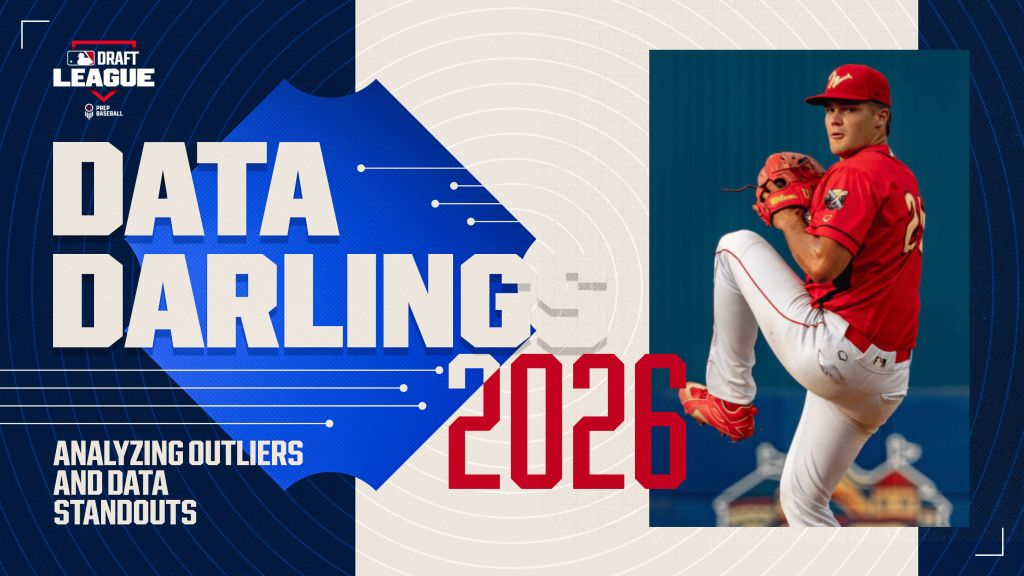
Working with each team’s Data Coordinators, every week we’ll share a select group of players, or “Data Darlings”, who throughout the week and season have set themselves apart from the league, their trends and how it has impacted their summers.
Nathan Earley, Aberdeen: South Florida’s leading power bat and run producer, the lefty-swinging first baseman has opened the second half with strength. On Opening Night, three of the four balls he put in play came with exit velocities over 90 mph with the hardest at 102.5. Earley would be hitless the next game but has bounced back going seven for his last 12 in the last three games. Over that stretch, the 22-year-old is averaging an exit velocity of 96.5 mph with a max of 107.2 via his 434-foot home run on Saturday, July 11. In the same game, Earley followed up with a 105.4 mph exit velocity for a triple and also eclipse 107 mph off the bat with a 107.1 mph single the following game. The swings and balls in play (.667 BABIP) have carried weight via a .734 wOBA that plays in-line with his expected clip of .731. With his various gaudy power metrics, the first baseman has hit the ball over 95 mph half the time for a 50% hard-hit rate and has done a solid job putting it on a rope with a 40% line drive rate.
Justin Abercrombie, Mahoning Valley: Appearing on Opening Night of the second half, Abercrombie recorded a two-inning save with a rising fastball and a sub-1,000 rpm splitter. Both pitches the right-hander threw for strikes with an overall clip of 69%, landing in the zone 62.1% of the time. The heater sat just shy of 93 mph with a max velocity of 94.9 with 2,283 rpm. On average, Abercrombie had 20.2 inches of induced vertical break with eight inches of arm-side movement. Paired with a splitter, it averaged 80 mph and spun more than 1,000 rpm once out of the 12 times he threw it, getting as low as 781 rpm. The horizontal movement was similar to his fastball at nine inches arm-side, but consisted of 2” IVB.
Nyan Hayes, State College: An Oregon State graduate, Hayes has only homered and doubled once this past spring through 44 games. However, his introduction in the MLB Draft League has been a different case. Going deep in the first three games of the second half, Hayes has also tripled, which led to the walk-off winner on Opening Night and doubled. His first two were consistent with an exit velocity of 97.7 mph. The first traveling 369 feet down the left field line against a 94 mph fastball. The next was a deeper shot to left center at 390 feet against a curveball on a full count. The second home run was also similar to the triple he hit the following at bat of his first where he went 387 feet in the same direction and off the wall as his hardest hit so far at 98.8 mph off the bat. The third came as a leadoff blast on the third pitch of Friday, July 10, 364 feet down the left field line as well with an exit velocity of 96.2 mph against a 91-mph fastball.
Kyle Salvati, Trenton: Out of Central Connecticut State, Salvati stands at six feet, six inches and uses his size all the way down the mound. With a fastball, slider and changeup, the 22-year-old averaged over seven feet of extension which helped him work two perfect innings on Thursday, July 9 and five strikeouts over two scoreless innings two days later. The fastball sat 92 mph and got up to 94.9 with 18 to 19 inches of induced vertical break. As his go-to pitch, the average of 7.2 feet of extension has helped give the illusion with his reach of it coming in faster while landing it for a strike more than half the time. The slider had a tighter bite to it with two to three inches of glove-side movement, sitting at 82 mph with 1,759 rpm. Finally, Salvati flashed a changeup at 87 mph with 14 inches of arm-side horizontal movement and spun at 1,829 rpm.
Ben Barrett, West Virginia: Before 2026, the last time Barrett hit in a game was during the summer of 2023, switching to pitching only in 2024 and 2025 for Florida State. This past spring, the Seminoles’ senior captain stepped back up to the plate in May, slashed .364/.404/.591 with a .995 OPS through 19 games and in a larger sample size with the Black Bears has not slowed down. In July alone, Barrett has carried a five game multi-hit streak with hits in six out of the last seven games he’s hit in. During the month, the two-way has a hard-hit rate of 52.9% with an average exit velocity of 90.6 mph. He has also crushed pitches with speed for a 100% zone-contact race against fastballs and an average exit velocity of 99.6 mph against sinkers. On the mound, Barrett has been a ground ball pitcher of a 72.2% grounder rate, utilizing a high-80’s, low-90’s fastball, sharp slider and changeup.
Ryker Walton, Williamsport: The right-hander got the Crosscutters’ second start of the new half and drastically varied his spin amongst four pitches to strike out five over five innings. Walton leads his arsenal with a 90-mph fastball that topped at an even 93 with over 2,500 rpm of spin. Featuring arm-side movement of about 10 inches, the fastball also consists of 18.5” of induced vertical break. The Austin Peay graduate follows up with a curveball that spins 3,148 rpm on average, maxing at 3,289. Thrown eight times, every pitch spun at over 3,000 rpm and twice resulted in a strikeout. For something more horizontal moving, Walton showcased a tight cutter in the mid-80’s with 2,535 rpm, 6.8 inches of IVB and 1.9 inches of glove-side movement. Rounding out his arsenal, the Crosscutter killed spin to 1,372 rpm on average for an 83-mph changeup with a foot of arm-side movement. Overall with his arsenal, Walton generated 12 whiffs as all five strikeouts came with a swing and a miss.
For more information about the MLB Draft League, visit mlbdraftleague.com or follow @mlbdraftleague and @draftleaguedata on X, and @mlbdraftleague on Instagram.