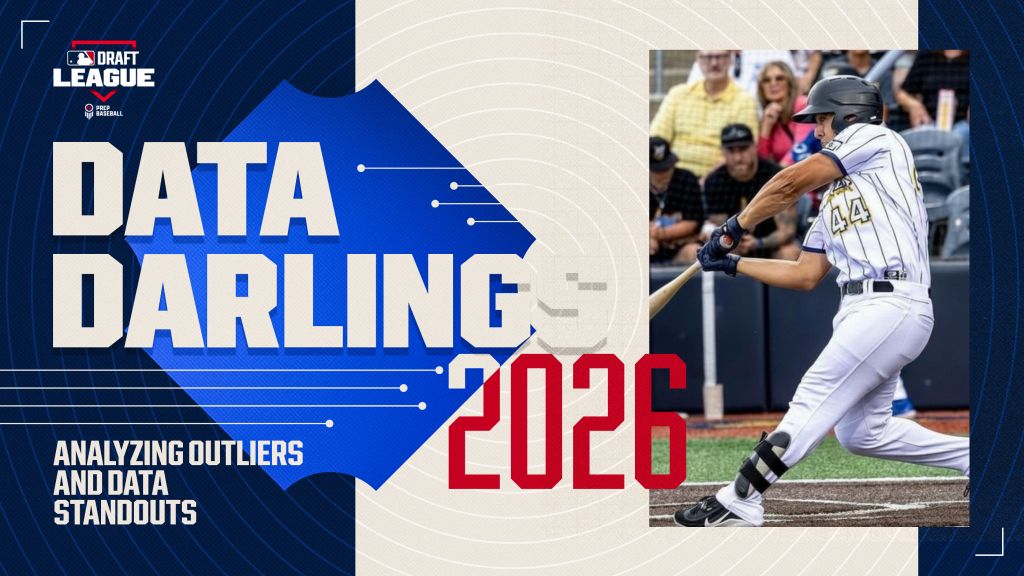
One aspect of the MLB Draft League that sets itself apart from other summer baseball leagues is its access and utilization of data capture. Each ballpark is equipped to capture live, in-game metrics and video to help further develop and scout the league’s prospects ahead of the MLB Draft.
Working with each team’s Data Coordinators, every week we’ll share a select group of players, or “Data Darlings”, who throughout the week and season have set themselves apart from the league, their trends and how it has impacted their summers.
Lyndon Glidewell, Aberdeen: Extreme horizontal movement and the ability to find strikes has set the Miami Hurricane up for success through three Draft League appearances after striking out 60 through 38.2 innings this past spring. Overall, the right-hander has seen his pitches result in strikes 70.2% of the time, painting the corners at a 37.9% clip. With the aforementioned horizontal movement, batters chase his pitches at a 37.1% rate, whiffing 32.8% of the time overall and with an in-zone whiff rate of 34.1%. Leading his three-pitch mix is a high-80’s, low-90’s sinker that has topped at 91.9 mph and spins 2350 rpm on average. Consisting of around 18” IVB, it’s got up to 20.4 inches of horizontal movement, sitting between around 17” arm-side. With a changeup, Glidewell has been able to get even more movement with an average of 18.8” arm-side while also slowing it down to 83.1 mph on average. The speed difference and movement has seen batters whiff half the time they swing overall and two-thirds of the time in the zone. For a breaking ball, the 21-year-old occasionally deploys a curveball with around 17 inches of horizontal movement the other way to catch right-handed batters out front and away. Sitting 79.3 mph with 2803 rpm, it consisted a whiff rate of 50% in the limited times it was thrown.
Collin Priest, Aberdeen: All summer Collin Priest has been putting bat to ball with authority. In the second game of the season, the recent Central Florida commit put three balls in play with exit velocities of 99 mph (RBI-double), 101.6 mph (RBI-single) and 108.3 mph (F9). While the success rate hasn’t been amongst the league’s best (.215 batting average), the left-handed bat has been one of the loudest bats, highlighted by his home run on Saturday, June 27. A solo home run in the ninth inning, Priest went 422 feet to right with an exit velocity of 112.1 mph. The hardest-hit home run in MLB Draft League history since 2022, it was also the third hardest hit with a positive launch angle behind Jose Fernandez’s 114.1 mph double and a 113 mph double from Judah Morris (16° LA, West Virginia 2025). Throughout the summer, Priest has been able to efficiently square the ball up with power, boasting a barrel rate of 31.6% and a hard-hit rate of 34.2%.
Drew Koenen, Mahoning Valley: Koenen joined the Scrappers on June 18 and features a high-spin four-pitch mix, led by a cutter/sweeper combination. The right-handed pitcher out of the University of Virginia attacks early with his cutter and utilizes the big breaking ball when ahead to put hitters away. The cutter averages 92.1 mph, peaking at 96.7 mph, and consistently generates high-spin in the 2642 range and runs it up to 2824rpm. The sweeper consistently generates -18 inches of horizontal break, peaking at -23.1 inches and the pitch has hit 3000rpm on three occasions and hit 3119rpm June 20. With these two pitches being thrown more than 50% of the time, they’ve helped generate a 50% ground ball rate and he’s still yet to allow a hard hit ball through 3.1 innings of work. With the weak contact, Koenen’s expected numbers should begin to even out as he logs more innings but the arsenal features different characteristics that have been difficult to barrel up in the MLB Draft League.
Luc Rising, Trenton: In five outings the Northeastern right-hander has been near perfect this summer, allowing one baserunner amongst the 24 batters he’s faced. Typically utilizing a fastball and curveball, he’s shown great command in the zone as well as consistency to miss bats. Across his 7.2 innings of work, the 22-year-old has placed his pitches in the zone 57.7% of the time and has whiff rates of 44.9% overall and 43.6% in the zone. Topping at an even 95 mph, the heater averages 93.5 mph with 2453 rpm. Rising gets plenty of ride at 21” IVB with 9.5” of horizontal movement. He’s landed it for strikes (71.1%) and finds the zone comfortably at 66.3%. Even in the zone so often, batters have whiffed at the fastball in the zone at a 44.4% rate and 48.8% overall. The curveball has a sharp, 12-6 action to his with -14” of IVB and roughly half a foot of horizontal movement.
Jose Fernandez, West Virginia: Coming off of a 2026 SWAC Player of the Year campaign, Jose Fernandez has kept the momentum going with just as much pop with a wood bat compared to metal. On Saturday, June 20, the 21-year-old catcher cracked a double with an exit velocity of 114 mph for the hardest hit this summer across the league. Hit with a launch angle of 12°, the two-run double is also the hardest hit with a positive angle in MLB Draft League history since 2022.
Luke Meyers, Williamsport: Luke Meyers biggest weapon on the mound is one of the league’s most devastating changeups, owning a whiff rate of 57.1% and generating 10 whiffs in his start on Saturday, June 20 against Aberdeen. The pitch averages just 30 rpm less than his fastball, but it comes in 10 mph slower and creates heavy horizontal action, averaging 21.8” HB and peaking at 26.2”. Meyers owns the top 13 pitches this summer with the most horizontal break, ranging between 23.9 and 26.2 inches. The pitch gets the job done in the zone, as well as generate chase, with an in-zone whiff rate of 50% and chase rate of 40.5%. The Washington State right-hander uses the changeup to keep lefties at bay, deploying it 50% of the time to lefties and down to 5% against right-handed hitters. Meyers has thrown the pitch for strikes 24 times and it’s been put in play five times, none of which have been hard hit and producing an average exit velocity of 74.6mph.
Carson Lane, State College: Everything was going Lane’s way on Sunday, June 28 with four hitless innings and six strikeouts. Utilizing a fastball, changeup, cutter and curveball, the Nevada-Las Vegas Rebel lived on the edges with a shadow rate of 37.9% and finding batters to chase 34.4% of the time. With 11 total whiffs, Lane carried a rate of 44.4% as batters swung and missed a quarter of the time in the zone. The heater sat 92.2 mph and topped an even 94 with 2054 rpm of spin. It consisted of a tight five inches of horizontal, arm-side movement and 17.2 inches of IVB. The most utilized pitch, it effectively had accounted for eight of the total whiffs (53.3%) and an in-zone rate of 36.4%. The changeup drops in velo and spin to 85.3 mph and 1718 rpm on average respectively with half a foot more in horizontal movement at 13.1” and consists of 5.7” IVB. Along with his other non-fastball offerings, batters chased the pitch 50% of the time and threw it for strikes at a 70% rate. The cutter featured the most spin on average in his arsenal with 2244 rpm, sitting at 86.2 mph. Along with the 50% chase rate, Lane’s cutter had batters whiffing half the time as well. Rounding out the arsenal, the Spikes’ right-hander had a downward curveball with -18.3” of IVB and -6.2” of horizontal, glove-side movement that spun 2144 rpm on average.
For more information about the MLB Draft League, visit mlbdraftleague.com or follow @mlbdraftleague and @draftleaguedata on X, and @mlbdraftleague on Instagram.