One aspect of the MLB Draft League that sets itself apart from other summer baseball leagues is its access and utilization of data capture. Each ballpark is equipped to capture live, in-game metrics and video to help further develop and scout the league’s prospects ahead of the MLB Draft.
Working with each team’s Data Coordinators, every week we’ll share a select group of players, or “Data Darlings”, who throughout the week and season have set themselves apart from the league, their trends and how it has impacted their summers.
Nick Greaney, Aberdeen: In his last four appearances (5.1 innings), Greaney has held opponents scoreless with his best outing coming on Sunday, July 26 with 2 1/3 no-hit innings and two strikeouts. Ending with his third win of the summer, the right-hander used a fastball, slider and splitter that all together found the zone 75% of the time. The fastball averaged 93.4 mph with a peak of 94.9 and spun around 2,200 rpm with 15.5 inches of induced vertical break and 12.5 inches of arm-side movement. The slider was averaging 82 mph with 2,000 to 2,252 rpm and featured up to 16.5 inches of glove-side movement with as low as negative 7.4 inches of IVB. The splitter was used to register both of his strikeouts at 84.1 and 83.3 mph respectively, spinning at 1,189 and 1,034 rpm. Freezing batters both times, it featured 7.9/3.1” and 4.7/1.8” HB/IVB.
Alex Kanipe, Mahoning Valley: The starting pitcher for the Scrappers’ combined shutout on Thursday, July 23, Kanipe struck out five over five with a deep five-pitch mix. Led by a low-90’s fastball, the right-hander topped at 92.1 mph with 2,000 to 2,100 rpm of spin, achieving up to 20 inches of induced vertical break and 7.4 inches of horizontal movement to the arm-side. He flashed a cutter with two to three inches of horizontal movement, sitting in the high-80’s with up to around 2,200 rpm on average, paired with a slider that slowed down in velocity and added more horizontal depth. Ranging between 82 and 83 mph, Kanipe spun it around 2,300 rpm with five inches of glove-side movement and had positive IVB from five to seven inches. He also threw a curveball that sat 77-79 mph with 2,200 to 2,300 rpm and had more depth at negative eight to nine inches of IVB with negative two to five inches of HB. Finally, the Butler graduate worked in a high-70’s splitter that killed spin down to 770 rpm with 10 to 13 inches of arm-side movement and one to four inches of IVB.
Justin Journette, State College: The Norfolk State graduate introduced himself to the league in loud fashion with a booming, 108.8-mph home run off the first pitch he saw in his second game. Before the end of the first half Journette would go deep again, also on the first pitch he saw in the game, traveling 430 feet to center field. To open the second week of the second half, the 22-year-old from RIchmond, Va. tapped into his power again and made history. On Monday, July 20, Journette went deep twice in back-to-back at bats. The first travelled 363 feet with an exit velocity of 101.4 mph and he followed it up with a 362-foot home run with an exit velocity of 106.1 mph that soared through the air with a 48-degree launch angle. The next day he went deep for the third time in two games with the longest home run in MLB Draft League history at 467 feet. With an exit velocity of 110.6 mph, it registered as the second hardest-hit home run since 2022. The blast beat out Dreylin Holmes’ 462-foot home run during the 2024 season and sits behind Collin Priest’s 112.1 mph exit velocity in the first half of this season. In the second half, Journette is averaging 91 mph in exit velocity with a 37.5% hard-hit rate and barreling baseballs at a 29.2% clip.
Billy Morris, Trenton: In the second half, Morris has brought high-spinning breaking balls to the Thunder’s starting rotation as he has struck out 20 over 15 2/3 innings. The slider which runs in the high-70’s and spins at 2,915 rpm on average with 7.6 inches of induced vertical break and 10 inches or horizontal glove-side movement. It’s been spun up to 3,135 rpm and has eclipsed the 3,000 mark almost 10 times. It's been his best pitch to generate whiffs with a 63.8% clip and 57.1% in-zone whiff rate and has been used as the strikeout pitch three times. He pairs it with a curveball that also spins beyond 2800 rpm and has even maxed out at 3279 rpm, spinning over 3,000 27 times. Averaging 75 mph with -2 inches IVB and -6.1 inches HB, it has also seen a decent amount of swing-and-miss with a 32.6% whiff rate and in-zone whiffs a quarter of the time. Deployed more often than the slider, it has accounted for 11 of Morris’ strikeouts.
Ian Collier, West Virginia: After leading Florida Atlantic with eight home runs in his graduate season, Collier has seen his power translate to a .526 slugging percentage and .958 OPS through 11 games with the Black Bears. Beneath his results, the right-handed hitter has carried a hard-hit rate of 62.5% with seven games registering an exit velocity of triple-digits (12 total). He averages 92.8 mph off the bat with his hardest base hit being 106.7 mph for a single. He’s put the ball 24 times in 34 at bats with a BABIP of .522 and carries a .462 wOBA (.411 xwOBA). The pitch Collier has done most of his damage against is the slider which he registered his hardest hit against with an average exit velocity of 90.9 mph (57.1% hard-hit rate), hitting .556, slugging .778 with a .714 BABIP and .632 wOBA.
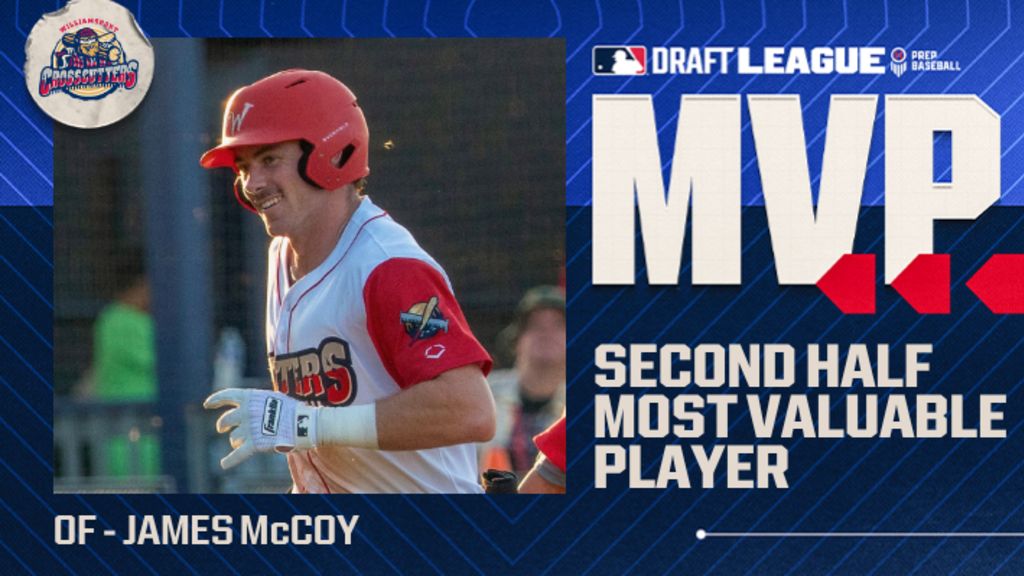
Josh Willitts, Williamsport: To open the week, the right-hander flashed a sinker, slider, sweeper and changeup to complete six shutout innings with five strikeouts and closed it with a similar start but one more strikeout. While the sinker was sitting 91.4 mph and peaked at 94 it got up to 24.1 inches of horizontal arm-side movement and averaged 17. 13 of the 87 times he threw it as well, it broke the 20-inch mark in horizontal movement, landing it in the zone shy of two-thirds of the time with an overall strike rate of 78.2%. He also spun it well with an average spin rate of 2,409 rpm. The slider had tight, half-foot movement to the glove-side (3.6 inches) with positive induced vertical break (one inch) as Willitts spun it with 2,577 rpm from 82 to 86 mph. With more horizontal break, the sweeper averaged 15.4 inches to the glove-side with -4.2” IVB and slowed down to an average of 80.5 mph. Willitts rounded out his arsenal with an 83 mph changeup that spun 1616 rpm with a little over a foot in arm-side horizontal movement with 4.9” IVB.
For more information about the MLB Draft League, visit mlbdraftleague.com or follow @mlbdraftleague and @draftleaguedata on X, and @mlbdraftleague on Instagram.