One aspect of the MLB Draft League that sets itself apart from other summer baseball leagues is its access and utilization of data capture. Each ballpark is equipped to capture live, in-game metrics and video to help further develop and scout the league’s prospects ahead of the MLB Draft.
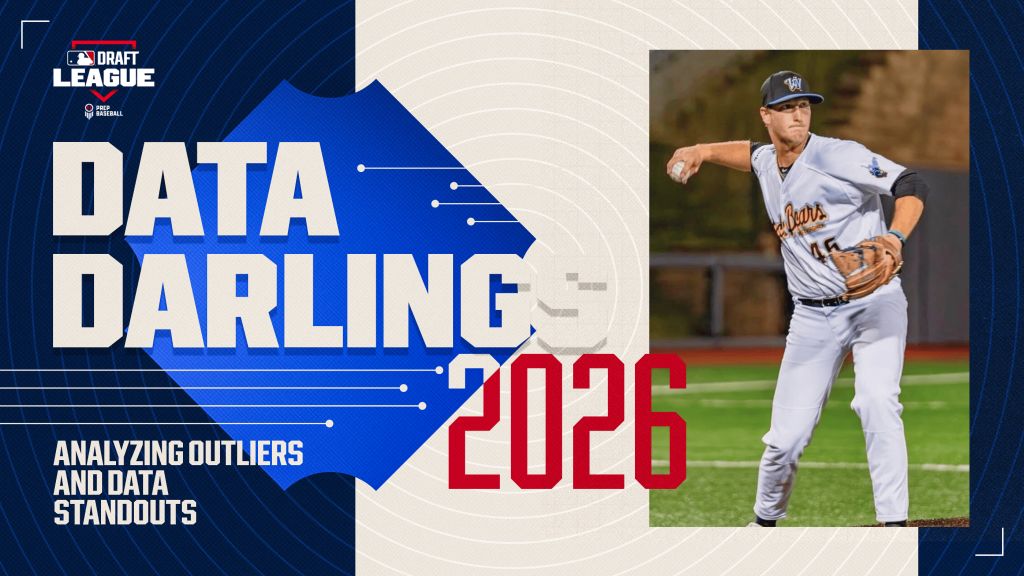
Working with each team’s Data Coordinators, every week we’ll share a select group of players, or “Data Darlings”, who throughout the week and season have set themselves apart from the league, their trends and how it has impacted their summers.
Patrick McCullough, Aberdeen: McCullough, a graduate of the University of West Georgia, entered August batting .217 and has swiftly raised it to .296 with 32 hits in 23 games this month. It’s a ground ball and line drive type of profile and utilizes the entire field with a 37.5% middle%, 37.5% oppo% and 25% pull%. His line drive rate of 24.7% this month is in the 95th percentile and he’s rarely whiffed on pitches in the zone with a zone contact rate of 91.3%. While only seven of his 32 hits this month have been extra bases and no home runs, there’s been steady hard contact with a hard hit rate of 29.6% and max exit velocity of 110.1mph. McCullough has struck out nine times in his 23 August games, compared to seven walks, which is led by a whiff rate of just 16.7% and put away rate of 15.3%. His K rate of 9.1% is in the 96th percentile. McCullough consistently puts balls in play to all fields, makes hard contact and rarely strikes out, making him a force in the middle of the IronBirds lineup.
Clayton Burke, Mahoning Valley: Burke has been hitting his stride lately, pitching back-to-back starts of six or more innings without allowing a run. The dominance over his past two starts has been led by his ability to paint the edges with a 36.8% shadow rate on all his pitches. While he only punched out seven over the 13 innings, he limited the hard contact with an average EV against of 81.9 mph and 90th percentile hard hit rate against of 24.3%. Burke deploys a pair of fastballs with a four-seamer at 89-92 mph and sinker at 88-91 mph with the effectiveness of both coming on location, landing both on the edges 41.5% of the time and for strikes 68%. Neither of his fastballs have been barreled once on 26 balls in play. The right-hander’s changeup is thrown exclusively to lefties and it’s held them at bay with a 47.1% whiff rate, 33.3% z-whiff rate and 34.8% chase rate. Averaging 79.6 mph, it creates 17.7 inches of horizontal break to 4.9 inches of IVB. Righties see the slider and curveball a combined 35% of the time and generate more ground balls than whiffs with a GB rate of 60% and average EV below 80 mph on both pitches. The curveball has more of a two-plane shape at -1.4 inches of IVB and -6.7 inches horizontal, while the slider has a shorter shape at 5.8 inches of IVB and -3.9 inches horizontal. With a plethora of pitches and ability to locate, Burke has been able to generate whiffs, ground balls and weak contact during his hot stretch in August.
Trey Cehajic, State College: With an ERA under 2.50 through five games (three starts) in August, the Tulane graduate has been an important factor in the Spikes’ push to compete in the MLB Draft League Championship. He’ll attack with a traditional four-pitch arsenal of a fastball, slider, curveball and changeup with plenty of swing-and-miss. In August, the heater is sitting at 91.5 mph with a peak velocity of an even 94 mph, spinning in the 2,200’s of rpm. With around six and a half feet of extension, Cehajic’s movement profile on the arsenal headliner features between 13 and 15 inches of induced vertical break with solid arm-side break between 10 and 13 inches on average. Used just as frequently is the slider which can be run up occasionally to give the appearance of a cutter. The speed ranges on average between 84 and 86.5 mph with just under 2,500 rpm. The right-hander throws it with positive verticality between three and five and a half inches of IVB with a tight three inches of horizontal break to the glove side. The curveball isn’t thrown often by Cehajic but its depth helps offer a more top-to-bottom approach versus the side-to-side attack of his other pitches. It runs in the low-80’s with around 2,400 rpm of spin, getting its depth with -9.2” of IVB and having five and a half inches of horizontal movement to the glove side like his cut-slider. The arsenal rounds out with a changeup that dips in spin below 1,500 rpm with the lowest being 1,097. With a similar direction of movement as the fastball, Cehajic gets a bit more horizontal break at 11.8 inches on average with an induced vertical break of four inches. Overall, he carries a strike rate of 65.6% which helps come from a chase rate of 29.6% and sees batters whiffing at a 34.1% clip and in the zone at 24.8%.
JuJu Stevens, Trenton: Returning to Trenton after hitting .314 with a .885 OPS in the first half of 2025, Stevens has brought even more impact when he’s in the lineup, with hits in 20 of the 22 games he’s taken at bats in. Carrying a hard-hit rate of 39.7%, he barreled pitches at a 20.6% clip with an average exit velocity of 88 mph (max 107.8). Stevens has consistently put the ball in the air with a combined fly ball and line drive rate of 62.5%. With pull-side power (40.6%), his swings have found their way to drop safely via a .433 BABIP, carrying impact with a .497 wOBA.
AJ Swader, Trenton: Rewarded with the final Player of the Week honor for the 2026 season, Swader’s summer has been one of production and power for Trenton. The infielder has boasted an average exit velocity of 90.4 mph, maxing at 109.5 mph on a pinch-hit home run on Aug. 21 on the second pitch he saw. Six of his home runs have come off the bat over 100 mph and three over 105 mph. He consistently drives the ball with a 41.3% hard-hit rate and a barrel rate of an even 14%, lining the ball at a 27.6% clip. Swader has been on the aggressive side at the plate with a 53.2% swing rate and chasing 30.6% of the time. However, it hasn’t negatively impacted his performance with a whiff rate under 20% and strikeout rate under 15. Having 19 extra-base hits and 32 RBI with some clutch to his game, the left-handed swinger has generated a wOBA of .450 that outperforms his expected number of .407.
Andrew Luczak, West Virginia: The right-hander out of Pittsburgh has been the Black Bears’ go-to reliever with a team leading 18 games. Amongst qualified pitchers, he carries the sixth lowest ERA of a 2.57 and has accumulated three saves in four opportunities. He utilizes four pitches, a sinker, slider, curveball and changeup that has seen solid chase and some swing-and-miss. The sinker, which has topped at 92.8 mph, averages 90.6 mph with elite spin for the pitch at 2,368 rpm. Its movement features an average induced vertical break of 13.5 inches with horizontal break to the arm-side at 18.1 inches and has ran as wide as 23 inches. With the velocity and extreme horizontal break, batters have chased 31.1% of the time. The slider features a bit of velocity and sometimes appears like a cutter, sitting 83.6 mph and has topped at 86.7 mph. He spins it between 2,600 and 2,700 rpm on average with positive IVB of one inch and tight horizontal glove-side break at 1.5 inches. It’s a bit more prone to be chased at with a 31.3% rate, and has generated plenty of whiffs at 38.5%. Adding depth and more swing-and-miss, Luczak’s curveball has generated a whiff rate of 47.6% and has seen batters wave in the zone a third of the time. He slows it down to 79.7 mph on average with 2,658 rpm, moving with negative 4.7” IVB and 5.2” of glove-side break. Overall, the Black Bear has seen batters chase at a 29.1% clip with a strikeout rate of 26.2% as he ranks third on the team and first amongst relievers with 32 total.
Tyler Muscar, Williamsport: The product of James Madison University has been the go-to left-hander in the Crosscutters second half bullpen and works predominantly with a high spin sinker and slider. Standing at 6-foot-5, Muscar does a good job getting downhill with extension into the 7-feet range and average of 6.6 feet, allowing his stuff to play up. The sinker sits at 88-90 mph and has peaked at 91 mph, creating plenty of ride and run with 15.9 inches of IVB and 13.6 inches of arm side run. The sinker averages 2,425 rpm spin, has been up to 2,589 rpm and lives on the edges 35.4% of the time. It also features a whiff rate of 23.4%, chase rate of 33.3% and strike rate of 68.5%. The slider at 81.9 mph is the putaway pitch and he spins it well with an average of 2,689 rpm and max of 2,942 rpm. The pitch gets two inches of IVB and 1.1 inches of horizontal. Leading his arsenal with a 26% put away rate, the pitch also has a 39.2% chase rate, 35.2% whiff rate and groundball rate of 52.6%. Muscar has allowed just one extra base hit on his slider and no home runs. He will also flash a rare changeup to right-handed hitters, averaging 83.8 mph, 2,254 rpm, 6.2 inches of IVB and 7.9 inches of arm side break. Since breaking into the league on July 29, Muscar’s fastball/slider combination has helped produce a 1.00 WHIP and .184 batting average against, both good for top five amongst relievers.
For more information about the MLB Draft League, visit mlbdraftleague.com or follow @mlbdraftleague and @draftleaguedata on X, and @mlbdraftleague on Instagram.