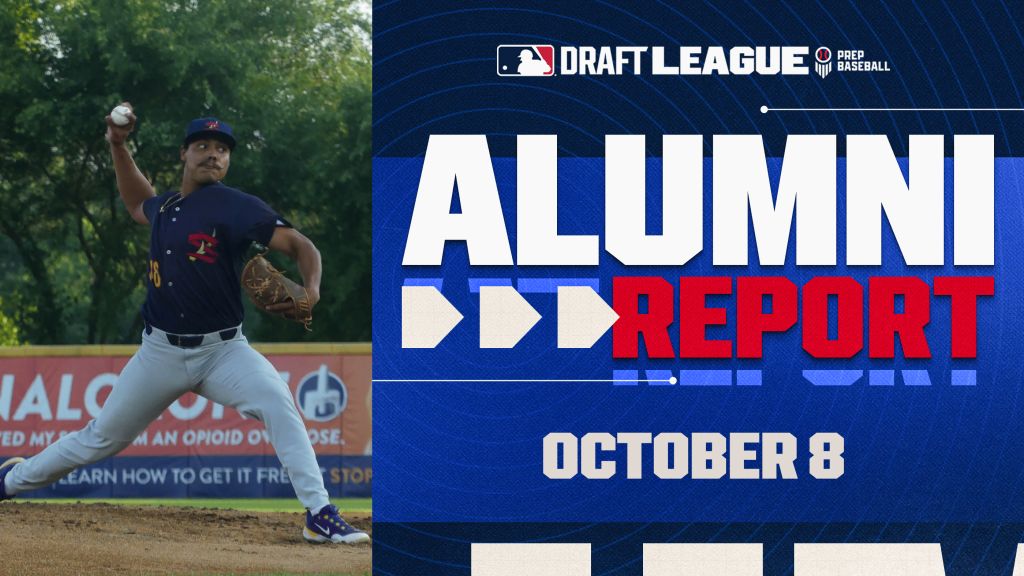
One aspect of the MLB Draft League that sets itself apart from other summer baseball leagues is its access and utilization of data capture. Each ballpark is equipped to capture live, in-game metrics and video to help further develop and scout the league’s prospects ahead of the MLB Draft.
Working with each team’s Data Coordinators, every week we’ll share a select group of players, or “Data Darlings”, who throughout the week and season have set themselves apart from the league, their trends and how it has impacted their summers.
Ryder Edwards, Aberdeen: The Oregon graduate has been the workhorse for the IronBirds in the second half, leading the team with 15 games out of the bullpen. Nine of those outings the right-hander didn’t allow a run and all season has been implementing a five-pitch mix of a fastball, cutter, slider, curveball and splitter. The primary fastball has been sitting in the 87-89 mph range but has seen it catch the low-90’s with his fastest clocking in at 92.7 mph. The spin typically ranges from the high 2,100s to 2,300s and has sometimes reached beyond 2,400 rpm with around 18 inches of induced vertical break and between six to 10 inches of horizontal arm-side movement. Edwards’ cutter averages around 86 mph with 2,211 rpm of spin. He gets a tight, three inches of glove-side horizontal break and just under 10 inches of IVB on it. The slider at 81.2mph is the main putaway pitch to both lefties and righties, creating 2,500+ spin and generating a 53.8% whiff rate, 40% in-zone whiff rate and 30.8% put away rate. He adds depth to his attack with the low-70s curveball that has rarely been thrown. It spins with rpm in the 2,300’s and sees his IVB drop beyond -10” with more horizontal break than the cutter at around -7 to -10 inches. He kills spin on his splitter, down to 660 rpm, and it has a similar horizontal profile to the fastball but with more downward action with about four inches of IVB.
Maddox Mihalakis, Mahoning Valley: Mihalakis’ run-production hasn’t come by any mistake with hard, quality contact and strong bat-to-ball abilities. He typically sends the ball up the middle 44.9% of the time when put in play and has a pull rate of 37.3%. However, he isn’t typically rolling over with a line drive and fly ball rate of 54.2%. He also punishes the baseball, averaging 90.4 mph in exit velocity with a max of 110 mph, and a 90th percentile exit velocity of 106.1 mph. The power has led to a hard-hit rate of 45.3% and a barrel rate of 17.9%, emphasizing the seven home runs and 20 extra-base hits. It’s not just the power numbers in his offensive game as he carries some solid contact data, starting with a 90.5% zone contact rate. His total contact rate sits at 82.2% with a strikeout rate of 16.3%, good for 71st percentile.
Caleb Ruter, State College: Left-hander Caleb Ruter out of Colorado Mesa has been finding his stride this month, allowing two or less runs in all three of his starts for a 3.38 ERA in August. The Spikes starting pitcher deploys six pitches, starting with a pair of fastballs in his sinker and four-seamer. The sinker keeps hitters at bay and generates ground balls with up to 22 inches of horizontal action, sitting around 17 inches on average at 87-90 mph. The four-seamer sits in a similar velo range at 87-90mph, but hovers in the 13-15 inch range of vertical and horizontal action and generates more whiffs than the sinker. There’s good feel for his changeup at 80-83 mph, averaging 1,675 rpm spin with -15 to -20 inches of running action, sitting right around the 0 IVB mark. With the sinker and changeup running to his arm side, he features a pair of breaking balls that create heavy horizontal action in the opposite direction. The sweeper at 75-77 mph creates over 2,700 rpm spin at its peak and creates 17-19 inches of glove side movement to just -3.7 inches of IVB. The curveball sits at a similar 76-77 mph and 2,700+ rpm but creates more vertical movement, sitting at -4.8 IVB and 15.5 inches of glove side movement. Ruter’s east/west profile in his arsenal is rounded out with a cutter and the six pitches have allowed him to navigate a strong month of August, despite not possessing big time velocity.
Joe Colucci, Trenton: The Virginia graduate has been a mainstay in the Thunder bullpen during both halves and has been in a groove of late with six straight scoreless appearances. Colucci is a groundball pitcher (51.0%), led by his sinker (58.6%), but also has a pair of put away pitches and swing through pitches with his curveball and changeup. The sinker has been up to 96.7mph, the hardest second half pitch from the Thunder, and lives in the 93.6-mph range. The heavy groundball rate comes from the 18.1 inch arm side movement to 8.8 inches of IVB. He locates it on the edges with a shadow rate of 32.4%, helping generate soft contact (82.6-mph avg EV). The curveball at 80.2 mph is the putaway pitch and has shorter break with -5.4” IVB and -7.3” horizontal. He deploys it 32.1% of the time and 39.7% to righties, generating a 46.5% whiff rate and up to 51.4% against righties. He lands it for strikes at a 63% clip and still generates chase at a 26.5% rate. The changeup is utilized almost exclusively to lefties and sits at 81.4 mph with 1,013 rpm, down to 710 rpm at its best. With 11 inches of arm side run to -0.7 inches of IVB, it owns a whiff rate of 40% and has only been put in play once in the second half.
Rene Lastres, West Virginia: Lastres, a graduate of Florida International, possesses one of the second half’s biggest weapons in his slider and has also ran his fastball up to 95.3 mph. The 6-foot-3, 210-pound right-hander throws the slider 19.8% of the time and it generates a jaw dropping whiff rate of 78.9%, zone whiff rate of 50% and chase rate of 37.1%. Sitting at 82.1 mph, 2,313 rpm, 6.0” IVB and -9.0” HB, it has only been put in play once and serves as the put away pitch with a rate of 50%. Lastres works off the fastball, throwing it over 60% of the time and sits at 92.9 mph with 17.2 inches of IVB and 10.1 inches of arm side run. Rounding out his arsenal is a cutter at 85.7 mph with 10.7” IVB and -2.2” glove side movement, along with a curveball at 75.2mph, -4.5” IVB and -13.8” glove side movement. He uses the curveball just 7% of the time and more often to righties, but the pitch generates equal whiff numbers to the slider and can be an important go-to pitch when the slider isn’t there. While he’s been generating strikeouts with 13 over his 10 1/3 innings, higher usage of the slider and curveball to get ahead could help unlock even more in the tank.
Matthew Mariano, Williamsport: The Crosscutters right-handed reliever has dominated the month of August, pitching 11 2/3 scoreless innings with 13 strikeouts to just four walks. Mariano leads with a riding fastball, sitting at 89.3 mph, 2,296 rpm, 21.7” IVB and 6.7” glove side movement. The pitch consistently peaks at 23-25 inches of IVB, helping generate a 27.8% whiff rate and 35.1% shadow rate. The curveball at 79.6mph gets the second most usage with 12-6 shape, sitting at -7.2” IVB and -0.3” HB. The pitch generates 30% whiffs, 25.6% chase and hasn’t been hit hard once on 15 balls in play. Getting slightly less usage but working as the more productive pitch, the slider sits at 82.3 mph with tight, short break at 1.3 inches of IVB and 2.2 inches of glove side movement. Working as the putaway secondary pitch, it generates a whiff rate of 46.4%, chase rate of 44.7% and lands it in zone for a strike rate of 67.8%. The changeup at 83.5 mph and 1,898 rpm is used almost exclusively to lefties. While it creates whiffs just 23.5% of the time, it creates a ton of soft contact with an average EV of 80.5 mph and hard hit rate of 10%.
For more information about the MLB Draft League, visit mlbdraftleague.com or follow @mlbdraftleague and @draftleaguedata on X, and @mlbdraftleague on Instagram.